
Non-Medical Home Care
Personal Care Services at Home
The hard part of personal care is not arranging it. It is that your mother does not want a stranger helping her wash, and she is not wrong to feel that way. Most failed care arrangements fail here, not over money or scheduling. Focus Family Care provides personal care services at home across seven South Florida and Treasure Coast counties.
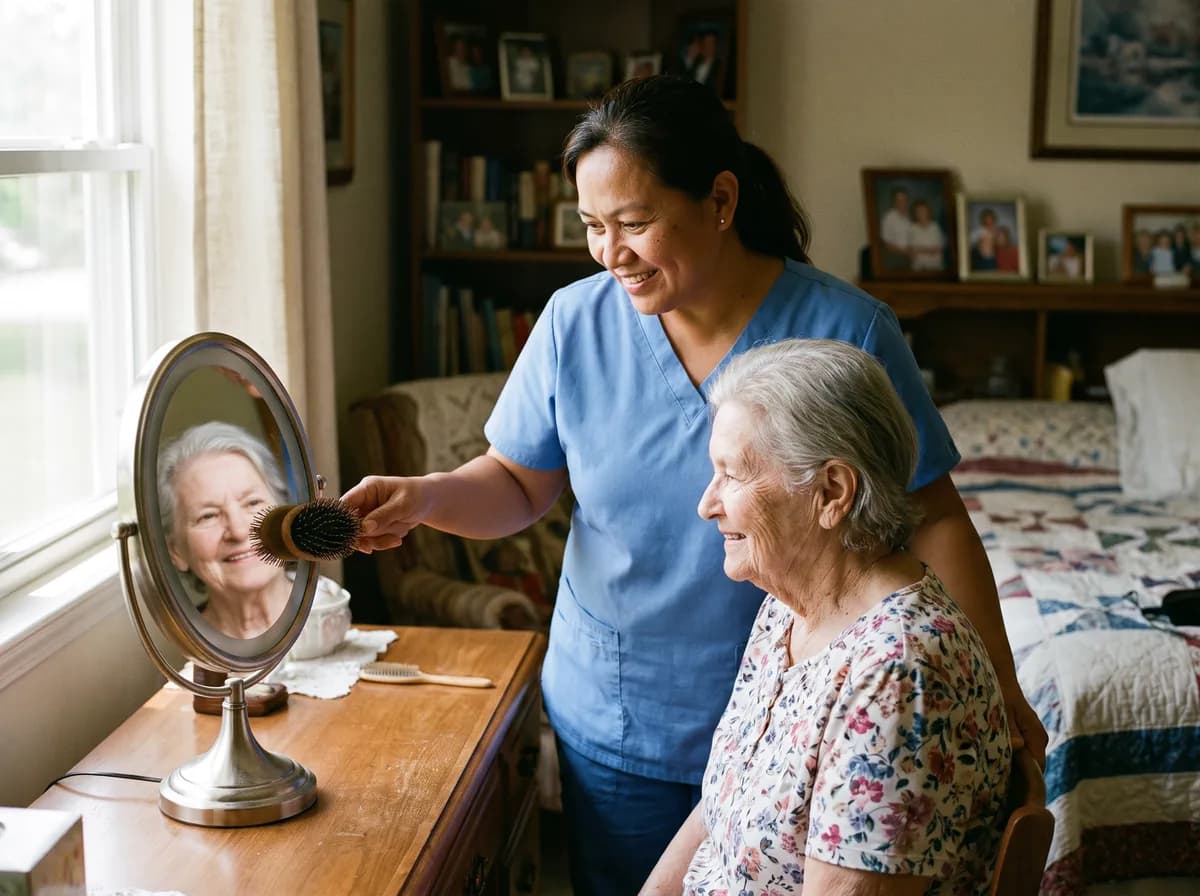
What Personal Care Includes
Bathing and Showering
As much or as little help as someone needs, with whatever they can still do left to them.
Dressing and Grooming
Clothes, hair, shaving and the small things that make a person feel like themselves.
Toileting and Continence Care
Handled matter-of-factly and without fuss, which is what preserves dignity.
Transfers and Mobility
Safe movement between bed, chair, bathroom and door, including after a fall.
Meal Preparation and Feeding
Cooking to preference and to diet, and help eating where that is needed.
Medication Reminders
Prompting and observation. A caregiver reminds; only a nurse may administer.
Light Housekeeping and Laundry
Keeping the home safe and orderly rather than doing a deep clean.
Transportation and Errands
Appointments, shopping and the outings that keep someone connected.
Supervision and Companionship
Being present, watching for change, and noticing what a visitor would not.
Quick Answer
Personal care is hands-on help with bathing, dressing, grooming, toileting, transfers and mobility. It is non-medical home care, so it needs no physician's order and Medicare does not fund it as an ongoing service. The practical difficulty is almost never finding a caregiver. It is getting the person to accept one.
Key Takeaways
- Most personal care arrangements fail over dignity, not money or scheduling.
- Start with the least intimate tasks. Trust is built on the boring ones and spent on the intimate ones.
- Gender preference is routine to arrange, and we ask at assessment rather than waiting for discomfort.
- Personal care is non-medical, so no physician's order is needed and Medicare does not fund it as ongoing care.
Nobody writes about the actual obstacle
Every agency page lists the same tasks. Bathing. Dressing. Toileting. Transfers. Meals. All true, and none of it addresses what actually happens in the house.
What happens is that a capable adult who has washed herself for eighty years is asked to let someone she met on Tuesday help her out of the shower. She says she is fine. She says she does not need it. She is embarrassed, and being embarrassed reads as being difficult.
Families then push, or give up, or the adult daughter does it herself. The third option is the most common and the most costly, and we will come back to it.
How to introduce personal care so it is accepted
- Start with the least intimate tasks: Not bathing. Begin with meals, laundry, driving to appointments, light housekeeping, company. Trust is built on the boring tasks and then spent on the intimate ones.
- Let them keep whatever they can still do: If she can wash her own face and arms but needs help with her back and her feet, that is the arrangement. Taking over everything because it is faster is the quickest way to lose cooperation, and it accelerates decline.
- Ask about gender preference and take it seriously: Many people have a strong preference about who helps them undress. It is a reasonable thing to want and a routine thing to arrange. We ask at assessment rather than waiting for someone to be uncomfortable enough to raise it.
- Mind the language: "Bathing assistance" sounds clinical and diminishing. "A hand getting in and out of the shower" is the same service described as help rather than as loss.
- Keep the same caregiver: This matters more in personal care than in any other service. Being undressed in front of a familiar person is manageable. Being undressed in front of a different person every week is not, and it is the point at which most people refuse care outright.
- Start before the crisis: Someone who chooses a caregiver while they are still well retains authorship of the arrangement. Someone who has a caregiver imposed after a fall has had a decision made about them.
The thing families should stop doing
If an adult child is providing intimate personal care for a parent, and it can be avoided, it usually should be.
This is uncomfortable advice and we give it anyway. Helping a parent with toileting changes the relationship in ways that are difficult to undo. It is exhausting, it breeds resentment that nobody will admit to, and it uses up the relationship's goodwill on tasks a paid caregiver can do without any of that weight.
Bringing in a caregiver for the intimate work lets a daughter go back to being a daughter. That is worth paying for on its own, separately from any practical consideration.
Where personal care ends and nursing begins
Personal care is non-medical home care. That is a legal boundary, not a judgment about difficulty, and it decides who may do what.
A caregiver may remind someone to take medication, hand them the bottle and watch them take it. Only a licensed nurse may administer it. The same line applies to wound care, injections, catheters and feeding tubes: a caregiver may keep the area clean and notice a problem, but the clinical task belongs to a nurse.
If the need crosses that line, the service you want is skilled nursing at home under a physician's order, or private duty nursing if someone needs a nurse present for hours at a time. Many households use a combination, with a nurse for the clinical tasks and a caregiver for the rest, which usually costs less than nursing hours alone.
Who pays for personal care
- Medicare does not fund ongoing personal care: It covers aide visits only alongside skilled services during a home health episode, and only while that episode lasts. This is the most common misunderstanding we correct.
- Florida Medicaid Long-Term Care can cover it: If you qualify. See Florida Medicaid Long-Term Care for how eligibility screening works.
- Long-term care insurance frequently covers it: Personal care is exactly what most policies were written for. Bring it to the assessment and we will check it against the hours you actually need, at no cost.
- Private pay: Quoted in writing before anything begins, and usually the most affordable of the three services on this page because no nurse is required.
What we can tell you about our caregivers
More than 100 Focus Family Care caregivers are available for personal care across the seven counties we serve. About a third are men and two thirds are women, so a preference for a male or a female caregiver can usually be met.
From your first call, the typical time to a first visit is 48 hours. Every caregiver passes a Florida Level 2 background screening, and a registered nurse writes and supervises every plan of care.
Where we provide personal care
Across Palm Beach, Broward, Miami-Dade, Martin, St. Lucie, Indian River and Okeechobee counties, with city pages for West Palm Beach, Boca Raton, Boynton Beach, Delray Beach, Jupiter, Palm Beach Gardens, Fort Lauderdale, Hollywood, Miami, Stuart, Port St. Lucie and Vero Beach.
How We Know This
Focus Family Care is a Florida-licensed home health agency and nurse registry (License NR #30211928, HHA #299995403) accredited by ACHC. Guidance on this page is reviewed by the agency's Director of Nursing, and coverage details are verified with each family's insurance before care begins.
Sources
Insurance & Payment
We Accept Medicare, Medicaid, Private Pay, and 100+ Insurance Plans
Focus Family Care accepts Medicare, Florida Medicaid, private pay, and more than 100 private insurance plans, including most long-term care policies. We verify your coverage at no charge before the first visit.





















Not sure what your plan covers? Call (561) 693-1311 for free insurance verification, no obligation.
Frequently Asked Questions
My father refuses to accept help. What do we do?
Start smaller than you think. Meals, driving, laundry, company, nothing intimate for the first few weeks. Almost everyone who refuses personal care will accept practical help, and the intimate tasks become possible once there is a relationship.
Is personal care the same as a personal care home?
No, and the similarity of the words causes real confusion. A personal care home is a residential facility someone moves into. Personal care is a service delivered in your own home.
Can we request a male or a female caregiver?
Yes, and you should say so at the assessment rather than waiting until someone is uncomfortable. About a third of our personal care caregivers are men and two thirds are women, so a preference can usually be met.
Will it be the same caregiver each time?
Continuity matters more in personal care than in any other service, so we match deliberately and keep the same caregiver wherever we can. Ask who your regular caregiver is and who the named backup is.
Does Medicare pay for personal care at home?
Not as an ongoing service. Medicare covers home health aide visits only alongside skilled nursing or therapy during a home health episode, and only while that episode lasts. Florida Medicaid Long-Term Care and long-term care insurance are the routes that do fund ongoing personal care.
Can we start with just a few hours a week?
Yes, and most families should. A few hours a week is enough to build a relationship, and it gives you a real look at how a caregiver fits before committing to more.
Request Home Health Care Today
Focus Family Care starts care in as little as 24 hours. Call now or request an in-home assessment. We answer around the clock.
515 N Flagler Drive, Ste 350, West Palm Beach, FL 33401