
Skilled Home Health Care
Occupational Therapy at Home
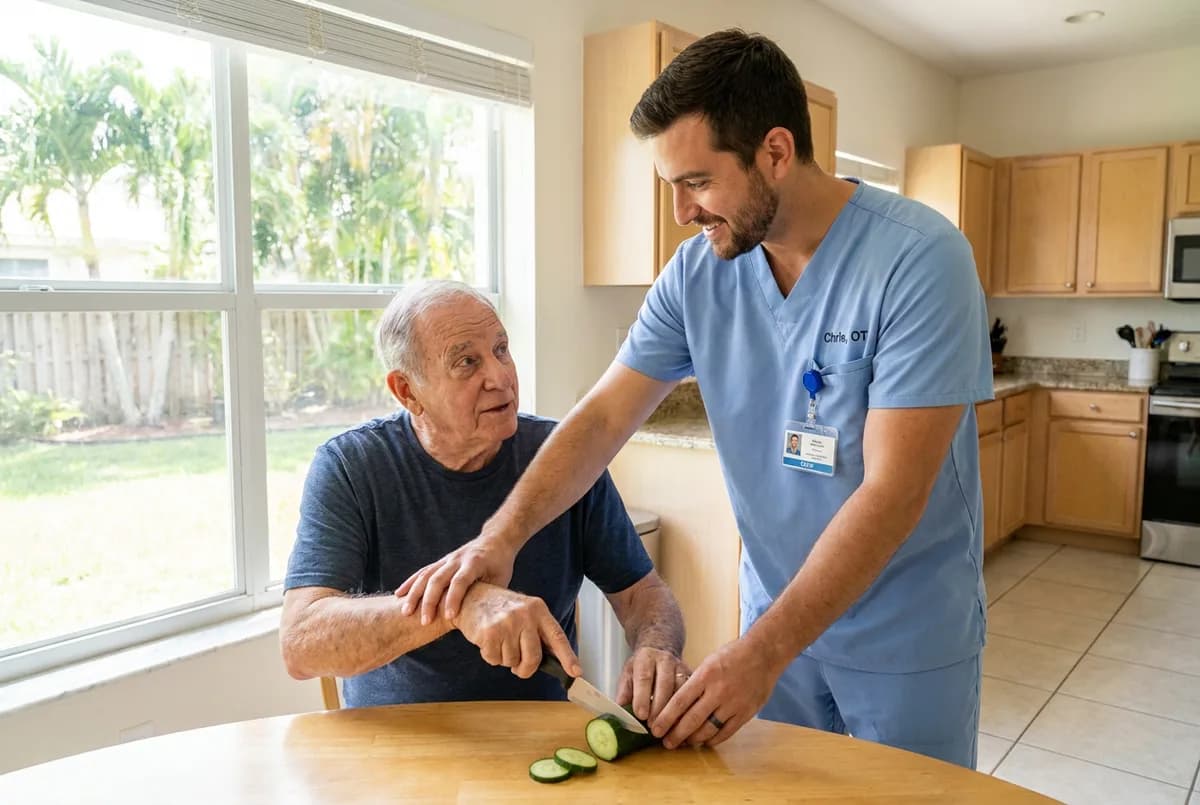
An occupational therapist is the only clinician who comes to your house to look at the house. Everyone else assesses the person. The OT assesses the doorway the walker will not fit through, the bed that is two inches too low to stand up from, and the rug at the top of the stairs. Focus Family Care provides occupational therapy at home across seven South Florida and Treasure Coast counties.
What an OT Home Visit Covers
Home Safety Assessment
Walking the house to find the hazards a clinic visit structurally cannot see.
Daily Task Retraining
Dressing, washing, cooking and transfers, relearned or done a different way.
Equipment Specification
The right grab rail, shower seat or raised toilet seat, in the place actually used.
Fall Prevention
Lighting, rugs, and the route from bed to bathroom where most night falls happen.
Environment Reorganization
Moving what is needed daily out of the reach-above and stoop-below zones.
Confidence After a Fall
The fear is frequently the bigger obstacle, and it is treatable.
Caregiver Training
Showing the household the safe way to help with a transfer or a shower.
Coordination With the Care Plan
Working alongside nursing, physical therapy and speech therapy at home.
Quick Answer
Occupational therapy is about the tasks of daily life: dressing, washing, cooking, getting to the toilet, getting in and out of bed. Physical therapy works on the body; occupational therapy works on what the body has to do. At home, an OT can change the house as well as the person, which is usually the faster route.
Key Takeaways
- Physical therapy asks whether you can raise your arm. Occupational therapy asks whether you can wash your hair.
- An OT can change the house as well as the person, which is often the faster route.
- Ask for a home safety assessment. It is the most under-requested visit in home health.
- OT at home is a skilled service, so it begins with a physician's order.
Occupational does not mean work
The word confuses almost everybody, including people already receiving the service.
In this context an occupation is not a job. It is any of the ordinary activities that occupy a day: washing, dressing, eating, cooking, using the bathroom, getting in and out of a chair, managing medication, getting to the store.
An occupational therapist's job is to get someone doing those things again, safely and as independently as possible. Sometimes by rebuilding the ability. Sometimes by changing the method. Sometimes by changing the environment so the ability is no longer required.
That third route is the one families never anticipate and the one that often works fastest.
The difference from physical therapy, concretely
Both are useful. They do different things and most people receive both.
- Physical therapy works on the body itself: Strength, balance, range of movement, walking, getting up from the floor. The goal is capability. See physical therapy at home.
- Occupational therapy works on the task: Actually getting into the bath, actually getting dressed with a frozen shoulder, actually making lunch with one usable hand. The goal is function.
Put simply
Physical therapy asks whether you can raise your arm. Occupational therapy asks whether you can wash your hair.
Someone can improve considerably in physical therapy and still be unable to manage their own bathroom, because the bathroom is the problem rather than the leg.
Why the home visit is the whole point
An OT seeing someone in a clinic is assessing them in a room they will never have to live in.
At home, the same clinician sees the actual conditions. Where the light switches are. Which chair he actually sits in. That the toilet is too low. That the kitchen cupboards need reaching above shoulder height. That the shower has a lip she cannot step over any more. That the walker does not turn in the hallway.
None of this appears in a clinic assessment, and all of it determines whether someone manages at home.
Typical things an OT changes on a first visit: rearranging where things are kept so nothing needed daily is above head height or below knee height. Raising a bed or a chair. Specifying a shower seat, a raised toilet seat, grab rails in the places actually used. Removing or securing rugs. Improving lighting on the route from bed to bathroom, which is where most night falls happen. Teaching a different way to get dressed, get up, or transfer.
Most of it is unglamorous and cheap. Collectively it is often the difference between coping and not.
When occupational therapy helps most
- After a stroke: Relearning dressing, eating and washing with one side affected, and adapting the environment for what does not fully return.
- After a fall: Both the physical recovery and the fear, which is frequently the bigger obstacle. An OT addresses the confidence as well as the hazard.
- After hip or knee replacement: Specific techniques for getting in and out of bed, the car, the bath, and the chair without breaching movement restrictions.
- With dementia: Simplifying tasks, using visual cues, and reordering the environment so familiar routines stay possible for longer. See Alzheimer's and dementia care.
- With Parkinson's, arthritis or multiple sclerosis: Adapting method and equipment as capability changes, and staying ahead of it rather than reacting.
- Before a discharge, ideally: A home safety assessment before someone comes home is worth considerably more than one after the first fall. See hospital to home care.
The visit nobody asks for
If you take one practical thing from this page, ask whether a home safety assessment is available.
It is a single visit. It costs comparatively little. It routinely prevents the fall that leads to the hospital admission that leads to the nursing home, and it is the most under-requested service in home health.
Ask the discharging clinician, the physician, or us.
How to get occupational therapy at home
OT at home is a skilled service, which means it begins with a physician's order rather than with us. Call the doctor before you call anyone else.
Medicare covers occupational therapy under the home health benefit when a physician orders it and the patient meets the eligibility requirements, including being homebound. The rules on whether OT alone can establish that eligibility, as distinct from continuing it, are technical. Ask the physician, or ask us and we will explain how it applies to your situation.
Florida Medicaid and most private insurance also cover it in various circumstances. We verify coverage at no charge before care begins.
Where no order is forthcoming, a home safety assessment can usually be arranged privately, and it does not cost much.
What we can tell you about our therapists
Thirty-five occupational therapists are on the Focus Family Care roster, covering every one of the seven counties we serve.
Once a physician's order arrives, the typical time to a first visit is 48 hours.
Where we provide occupational therapy at home
Occupational therapy at home across Palm Beach, Broward, Miami-Dade, Martin, St. Lucie, Indian River and Okeechobee counties, alongside physical therapy and speech therapy at home.
How We Know This
Focus Family Care is a Florida-licensed home health agency and nurse registry (License NR #30211928, HHA #299995403) accredited by ACHC. Guidance on this page is reviewed by the agency's Director of Nursing, and coverage details are verified with each family's insurance before care begins. Eligibility is determined by your physician and your plan, not by us.
Sources
- Medicare.gov, Home health services coverage
- Florida Agency for Health Care Administration (AHCA)
- National Institute on Aging, Aging in place
- Medicare.gov, What's home health care, including the homebound requirement
- Florida Department of Elder Affairs, Statewide Medicaid Managed Care Long-Term Care Program
Insurance & Payment
We Accept Medicare, Medicaid, Private Pay, and 100+ Insurance Plans
Focus Family Care accepts Medicare, Florida Medicaid, private pay, and more than 100 private insurance plans, including most long-term care policies. We verify your coverage at no charge before the first visit.





















Not sure what your plan covers? Call (561) 693-1311 for free insurance verification, no obligation.
Frequently Asked Questions
What is the difference between occupational therapy and physical therapy?
Physical therapy works on the body, meaning strength, balance and walking. Occupational therapy works on daily tasks, meaning dressing, bathing, cooking and transfers. Most people benefit from both.
Do we need a doctor's order?
Yes for skilled occupational therapy. A home safety assessment can sometimes be arranged privately without one.
Does Medicare pay for occupational therapy at home?
Under the home health benefit, when a physician orders it and the eligibility criteria are met, including being homebound. Ask Focus Family Care and we will explain how it applies to your situation.
What will the therapist actually do on the first visit?
Watch how the person moves around their own home, ask what has become difficult, and identify what can be changed quickly. Expect practical suggestions the same day rather than an exercise sheet.
Is it worth it if my mother is not going to recover fully?
Frequently yes, and this is the misconception worth correcting. Occupational therapy is not only about recovery. It is about making what someone can still do enough for the life they actually live.
Can an OT recommend equipment?
Yes, and specifying the right equipment for the actual house is a large part of the job. The wrong grab rail in the wrong place is worse than none, because it gets trusted.
How quickly can an occupational therapist visit?
Once a physician's order arrives, the typical time to a first visit is 48 hours. Thirty-five occupational therapists are on the roster, covering all seven counties Focus Family Care serves.
Request Home Health Care Today
Focus Family Care starts care in as little as 24 hours. Call now or request an in-home assessment. We answer around the clock.
515 N Flagler Drive, Ste 350, West Palm Beach, FL 33401