
Condition Guide
Cerebral Palsy: Types, Causes, and Care at Home
Cerebral palsy (CP) is the most common motor disability in childhood, affecting movement and posture. This guide explains what cerebral palsy is, its types and causes, common associated conditions, and how home care helps a person live well at home.
Quick Answer
Cerebral palsy (CP) is a group of disorders that affect movement, muscle tone, and posture, caused by abnormal development of or damage to the brain, usually before or around birth. It is the most common motor disability in childhood. The main types are spastic, dyskinetic, ataxic, and mixed, and home care helps with mobility, feeding, therapy, and daily living.
Key Takeaways
- Cerebral palsy affects movement, muscle tone, and posture.
- It is caused by abnormal brain development or injury, usually before or around birth.
- The main types are spastic, dyskinetic, ataxic, and mixed.
- Home care supports mobility, feeding, therapy, and daily living for children and adults.
What Is Cerebral Palsy?
Cerebral palsy is a group of lifelong conditions that affect a person's ability to move and maintain balance and posture. It is caused by damage to or abnormal development of the developing brain, most often before birth. CP is the most common motor disability in childhood. It is not progressive, meaning the brain injury itself does not worsen, though symptoms can change over time.
Types of Cerebral Palsy
Cerebral palsy is grouped by how it affects movement:
- Spastic CP: The most common type, causing stiff muscles and difficult movement.
- Dyskinetic CP: Causing uncontrolled, involuntary movements of the arms, legs, or face.
- Ataxic CP: Affecting balance and coordination, making precise movements hard.
- Mixed CP: A combination of more than one type.
Causes and Associated Conditions
Cerebral palsy results from abnormal brain development or injury that affects the areas controlling movement. It can be linked to premature birth, low birth weight, infections during pregnancy, or a lack of oxygen. People with CP may also have associated conditions such as seizures, intellectual or learning differences, vision or hearing changes, and feeding or speech challenges.
Home Care for Cerebral Palsy
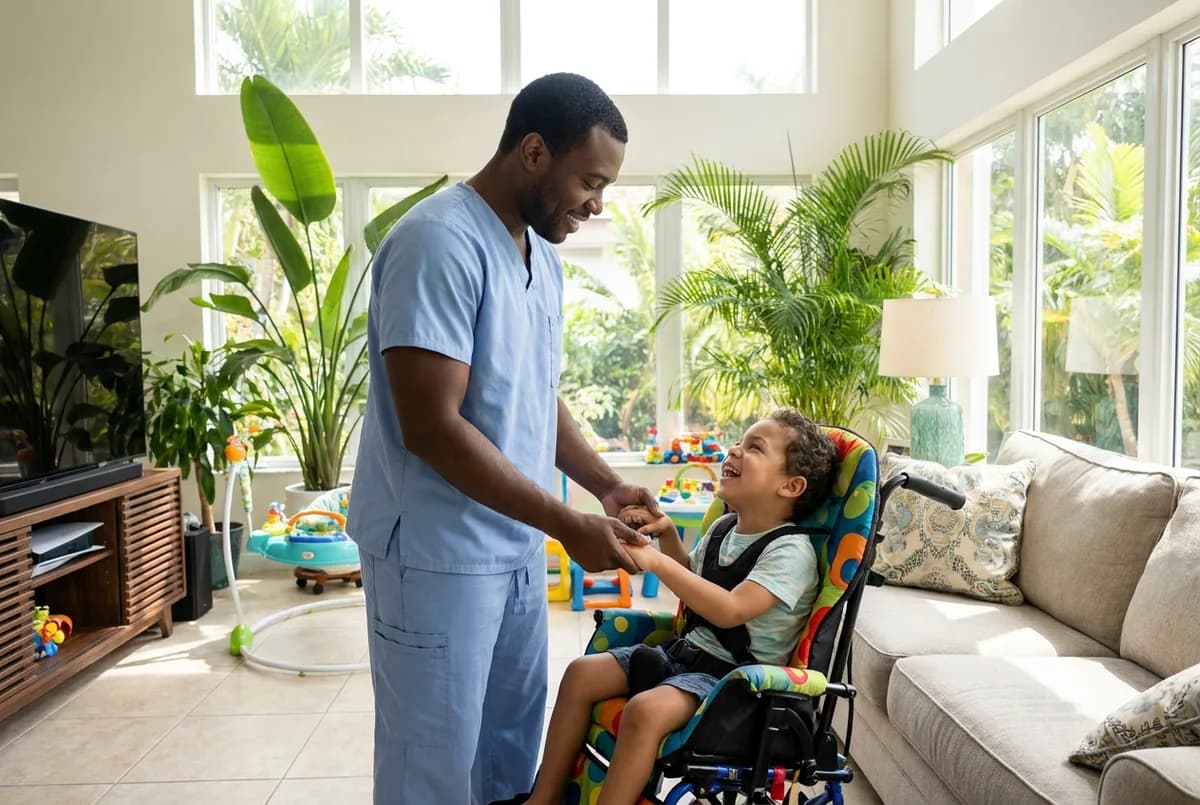
Home care helps a person with cerebral palsy stay comfortable, safe, and as independent as possible. Caregivers assist with mobility and transfers, feeding, personal care, and therapy routines, and skilled nurses support more complex needs. Focus Family Care provides cerebral palsy home care across South Florida, and coordinates pediatric home care and therapy at home when needed.
How We Know This
This educational guide is reviewed by Focus Family Care's Director of Nursing, a licensed APRN. It summarizes general information from the sources below and is not a substitute for advice from your own physician. Focus Family Care is a Florida-licensed home health agency and nurse registry (NR #30211928, HHA #299995403).
Sources
Frequently Asked Questions
What is cerebral palsy?
Cerebral palsy is a group of disorders that affect movement, muscle tone, and posture, caused by abnormal development of or damage to the developing brain, usually before or around birth. It is the most common motor disability in childhood.
What are the types of cerebral palsy?
The main types are spastic (stiff muscles), dyskinetic (involuntary movements), ataxic (balance and coordination problems), and mixed, which combines more than one type.
What causes cerebral palsy?
Cerebral palsy is caused by abnormal brain development or injury affecting movement control, often linked to premature birth, low birth weight, infections during pregnancy, or lack of oxygen.
How does home care help with cerebral palsy?
Home care assists with mobility, transfers, feeding, personal care, and therapy routines, with skilled nursing for complex needs, so a person can live safely and comfortably at home. Focus Family Care provides cerebral palsy home care across South Florida.
Request Home Health Care Today
Focus Family Care starts care in as little as 24 hours. Call now or request an in-home assessment. We answer around the clock.
515 N Flagler Drive, Ste 350, West Palm Beach, FL 33401