Non-Medical Home Care
Home Health Aides
Families call up asking for "an aide" and get answered in initials. HHA. CNA. PCA. Companion. Caregiver. These are not the same job, they are not interchangeable, and the difference between them is not seniority. It is what the person is permitted to do when something goes wrong. Focus Family Care places home health aides across seven South Florida and Treasure Coast counties.
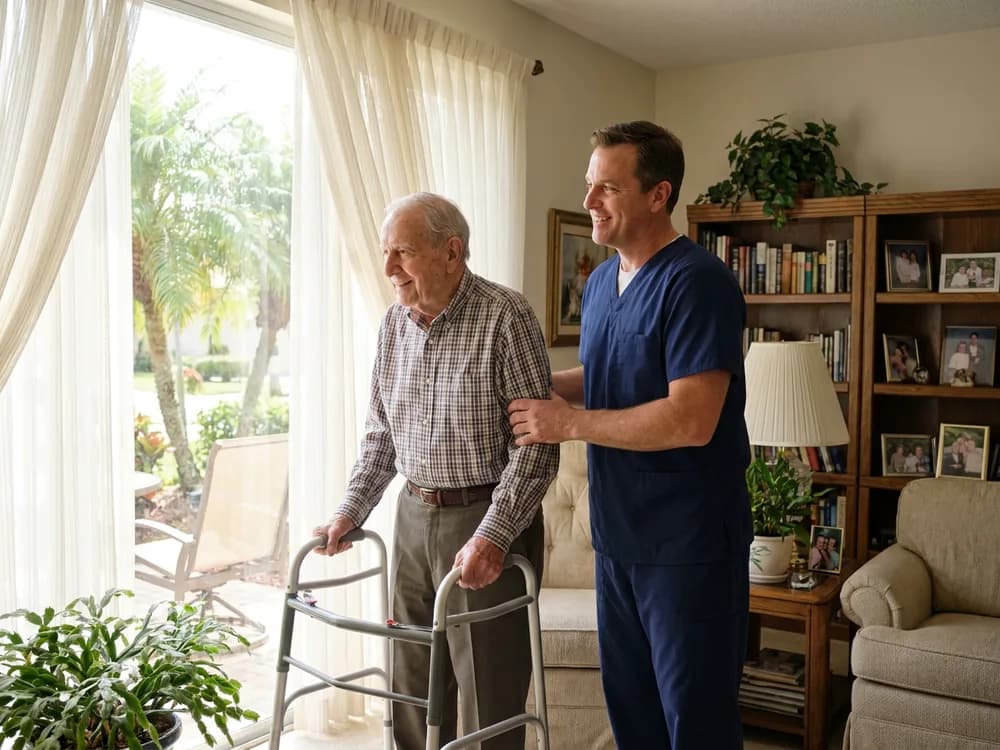
What a Home Health Aide Does on an Ordinary Day
Bathing and Personal Hygiene
Showering, washing and the parts of the day people most want help with least.
Dressing and Grooming
Clothes, hair and the small things that make someone feel like themselves.
Toileting and Skin Checks
Continence care handled matter-of-factly, with skin integrity watched.
Transfers and Mobility
The highest-risk part of the day, and the reason a trained aide beats a willing relative.
Meals and Eating
Prepared to dietary requirements, with help eating where that is needed.
Medication Reminders
Prompting and help with self-administration. Administering is a nursing task.
Light Housekeeping
Laundry and linens in the areas the client actually uses.
Observing and Reporting
What they ate, how they moved, what was different today. The part families undervalue most.
Quick Answer
A home health aide provides hands-on daily help at home, including bathing, dressing, transfers and meals, under the supervision of a registered nurse. A certified nursing assistant has more clinical training and usually works in facilities, though many work in homes too. Neither can administer medication, dress a wound or make a clinical judgment. If you need any of that, you need a nurse, and more aide hours will not substitute.
Key Takeaways
- The difference between the titles is not seniority. It is what the person is permitted to do.
- An aide cannot administer medication. Reminding and helping with self-administration are different things.
- The real question is not HHA versus CNA. It is whether the daily routine contains a nursing task.
- For ordinary personal care, the person matters more than the credential.
The four rungs, in plain terms
Nobody explains this at the point of inquiry, so here it is in the order of what each person can do.
- Companion or homemaker: Company, conversation, meals, errands, laundry, driving, keeping an eye on things. No hands-on personal care. If someone needs help getting into the shower, this is the wrong rung. See companion care.
- Home health aide (HHA): Hands-on personal care: bathing, dressing, grooming, toileting, transfers, mobility, feeding. Completes a state-approved training program and works under the supervision of a registered nurse. This is the rung most families actually need and the one they are usually quoted.
- Certified nursing assistant (CNA): Certified through the Florida Board of Nursing and listed on the state registry, with more clinical training than an HHA. CNAs are the standard in nursing homes and hospitals, and plenty also work in private homes. Everything an HHA does, with a broader clinical grounding behind it.
- Licensed nurse (LPN or RN): Medication administration, injections, wound care, catheters, tube feeding, assessment. A different category of worker entirely, at a different rate. See skilled nursing at home.
What an aide is not permitted to do
At Focus Family Care, every aide and assistant on any of these rungs is Level 2 background screened before entering a home, and works under a plan of care written by a registered nurse.
This is where placements go wrong, and it goes wrong in the same way every time.
An aide can remind someone to take their medication and can help with self-administration. An aide cannot administer medication, give an injection, dress a wound, change a sterile dressing, manage a catheter or a feeding tube, or make a clinical judgment about whether something is serious.
Those are nursing tasks. They stay nursing tasks regardless of how experienced the aide is, how long they have known the family, or how willing they are to help.
So the decision is not really HHA versus CNA. It is this: does the daily routine include anything on that list? If it does, you need nursing hours in the plan, even a short visit, and the aide covers everything else. If it does not, an aide is the right and considerably cheaper answer.
Families who get this wrong tend to get it wrong in the expensive direction, booking a nurse for a job an aide could do. But the dangerous direction is the other one, booking an aide for a household where somebody is quietly hoping they will handle the insulin.
So does HHA or CNA matter for my mother?
Honestly, less than people expect, and less than the person you match with.
For ordinary personal care at home, a good HHA and a good CNA will do the same work to the same standard. A CNA's extra training shows up in clinical settings and in reading a deteriorating situation. If the person is medically complex, unstable, or recently discharged, that experience is worth asking for by name.
For most households, the things that determine whether the arrangement works are not on anybody's certificate: does this person turn up, do they turn up on time, do they get on with your mother, and do they notice when something has changed.
Ask us for the rung you need. Then ask about the person.
Observing and reporting is the underrated part
An aide in the house four mornings a week sees deterioration weeks before a monthly appointment does. What they ate, how they moved, what was different today.
That is the part families undervalue and the part a supervising nurse relies on. It is also what separates a care service from someone simply being present.
What it costs, and what moves the number
Aide care is billed hourly and quoted in writing before anything begins. Two things move the rate: how many hours a week you need, and how physically involved the care is. There are no evening or weekend differentials, so a Saturday morning costs what a Tuesday morning costs.
One practical point reduces the bill and is routinely missed. Where some nursing is genuinely required, putting nurse hours only against the tasks that demand a license and aide hours everywhere else nearly always lands below a single higher-rate booking covering both. Tell us the routine and we will mark up which is which.
A long-term care policy, if one exists anywhere in the family paperwork, pays for aide hours far more often than households expect. Send it over and a coordinator will go through the wording with you at no cost.
Medicare covers aide services only as part of a skilled home health episode a physician has ordered, alongside nursing or therapy rather than on its own. Florida's Medicaid Long-Term Care program may pay for aide hours for those who qualify, and eligibility is screened by the Area Agency on Aging covering your county. Beyond those two routes, aide care is privately paid.
What we can tell you about staffing
The smallest booking we accept is four hours.
When your regular aide is unavailable, a backup aide covers the shift. We keep backups available rather than leaving a household to find its own cover, which is the question worth asking any agency before you sign.
Where we place home health aides
Home health aides across Palm Beach, Broward, Miami-Dade, Martin, St. Lucie, Indian River and Okeechobee counties. See also personal care for the service itself, and non-medical home care for how the services fit together.
How We Know This
Focus Family Care is a Florida-licensed home health agency and nurse registry (License NR #30211928, HHA #299995403) accredited by ACHC. Guidance on this page is reviewed by the agency's Director of Nursing, and coverage details are verified with each family's insurance before care begins. Scope of practice is set by Florida law and by each worker's credential, not by us.
Sources
- Medicare.gov, Home health services coverage
- Florida Agency for Health Care Administration (AHCA)
- National Institute on Aging, Aging in place
- Florida Board of Nursing, Certified Nursing Assistant certification
- Florida AHCA, Background Screening Clearinghouse
- Florida Department of Elder Affairs, Statewide Medicaid Managed Care Long-Term Care Program
Insurance & Payment
We Accept Medicare, Medicaid, Private Pay, and 100+ Insurance Plans
Focus Family Care accepts Medicare, Florida Medicaid, private pay, and more than 100 private insurance plans, including most long-term care policies. We verify your coverage at no charge before the first visit.



















Not sure what your plan covers? Call (561) 693-1311 for free insurance verification, no obligation.
Frequently Asked Questions
What is the difference between a home health aide and a CNA?
An HHA completes a state-approved training program and provides hands-on daily care under nurse supervision. A CNA is certified through the Florida Board of Nursing, appears on the state registry, and has more clinical training. Both provide personal care; the CNA's extra training matters most where the situation is medically complex.
What is the difference between a home health aide and a caregiver?
Caregiver is a general word, not a credential. It covers everyone from a companion to a certified aide. Ask which rung you are being quoted, because the rate and the permitted tasks both change.
Can a home health aide give medication?
No. An aide can remind and can help with self-administration. Administering medication, including injections, is a nursing task. Ask Focus Family Care and we will tell you which hours need a nurse.
How much does a home health aide cost?
It is billed hourly and quoted in writing, and it varies with the hours and the level of care. There are no evening or weekend differentials. Ask whether a mix of aide and nurse hours would cost less than what you are being quoted.
What is the smallest booking you accept?
Four hours. There is no minimum weekly commitment, so you can start with a single visit a week and increase from there.
What happens if our regular aide is unavailable?
A backup aide covers the shift. Focus Family Care keeps backups available rather than leaving a household to find its own cover.
Is a home health aide the same as a personal care assistant?
The work overlaps almost entirely. The titles differ by training route and by state. What matters is the permitted tasks, not the acronym.
Does Medicare pay for a home health aide?
Only as part of a skilled home health episode ordered by a physician. Medicare does not fund aide hours on their own.
Request Home Health Care Today
Focus Family Care starts care in as little as 24 hours. Call now or request an in-home assessment. We answer around the clock.
515 N Flagler Drive, Ste 350, West Palm Beach, FL 33401